GOcacao

Founder
Fermentation decides cacao quality, but smallholders can't easily tell how a batch is going. I started GOcacao with fermentation experiments in my backyard shed. It had 2 aims: help beginners learn to ferment, and help experienced fermenters produce more consistent, higher-quality beans.
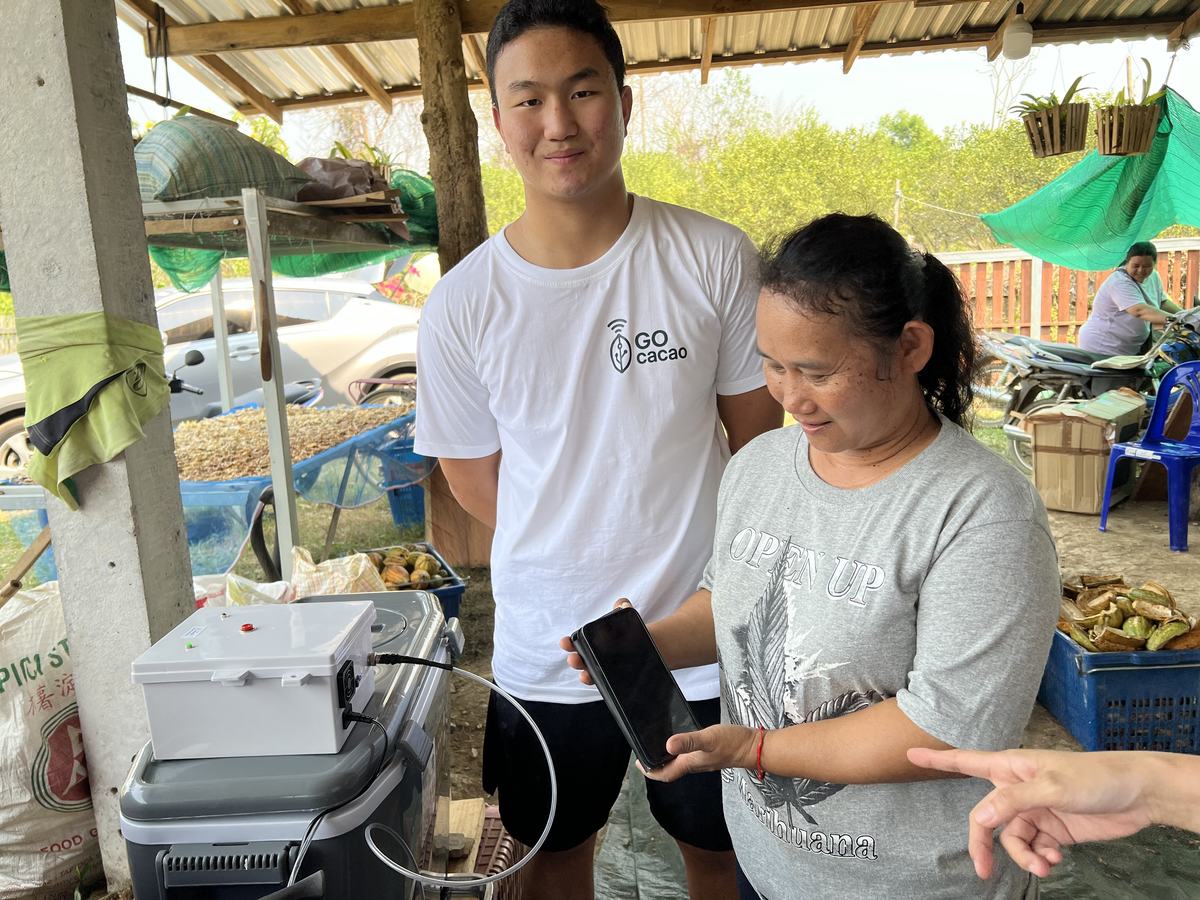
It's an embedded system pairing an ESP32 microcontroller with a PT100 RTD sensor. I designed its detection logic, which smooths the temperature signal with an exponential moving average (EMA) and waits for a sustained drop below the peak, so it signals when to turn the beans and when to stop. It stays silent through the first 48 hours, the anaerobic yeast phase, and has fail-safes for overlong cycles and overheating. Asst. Prof. Dr. Thansiphorn Na Nan, Director of Chulalongkorn University's cacao research center (ISTC), advised me on the fermentation process. It uses built-in cellular connectivity, so it works at farms without Wi-Fi.
A cooperative in Phrae that used it sold its cacao at a 30% premium above the prevailing average market price. Trials ran at 8 sites, and I'm now in discussions with groups in West Africa and Bolivia.
- +30% premium above average market price
- 5+ tonnes monitored
- 20.3% more well-fermented beans
Trial results from 8 batches, cut-tested independently.
Learn more: how I tested GOcacao
Extended Project Qualification (EPQ)Does real-time temperature monitoring improve fermentation quality and reduce fermentation duration compared to traditional fixed-schedule fermentation in smallholder cacao production?
At a cooperative in Sa Kaeo I fermented 8 batches, 4 with real-time adaptive turning and stopping and 4 on a fixed schedule, and had every batch cut-tested independently. The adaptive batches had 20.3% more well-fermented beans and 23.2% more grade-4 fissuring beans (the top grade). They also varied 48.7% less between batches and finished 7.1% sooner.